Monday, June 30, 2008

Religious Liberty Trumps Sanity in Texas

The Texas State Supreme Court last week ruled that a church member had no right to sue a church for damages inflicted to her in the course of “church activities for which members adhere.” The case involved a 17-year-old girl who happed to be a victim of a “spiritually charged” garage sale preparation in which fellow believers became convinced she was possessed by a demon. She was forcibly restrained and “laid hands on her” in an exorcism for several hours despite her pleading to be set free. Amazingly, she returned to the church at a later date when a similar episode occurred again. Her family sued the church for abuse, false imprisonment, and distress; she suffered post-traumatic stress disorder from the incident among other psychological fallout. An appeals court later lessened the original award of $300,000 to $120,000. A further appeal resulted in the Texas state Supreme Court ruling, which threw out the suit with a 6-3 verdict.

I find this ruling disturbing on many levels. First, there is no such thing as demons. The church members were caught up in a mass hysteria amplified by her non-participation. Courts of law dismissed spectral evidence as valid after the infamous 1662 Salem Witch Trials. The Texas Supreme Court should have been able to discern that demons are nonsense and that the church members got caught up in a mass hysteria for which they bore responsibility. The court seems to be saying that people, in a state of religious frenzy bear no responsibility for their actions.

Next, we’re talking about an underage girl without her parents present. She did not consent to whatever spiritual rape was inflicted on her. What about the idea of the state protecting children from harm? Didn’t the state just remove 400+ children from the FLDS compound because they were in danger of child sexual abuse? Perhaps this is not an equal comparison as the FLDS kids were brainwashed from birth. Presumably, the victim in this case had “chosen” by her free will to be part of the religious proceedings. She’s under age, however and cannot consent to being abused. The state got it wrong on this account, too. Perhaps cults should adopt a “safe word” concept so that people can escape when they’re not feeling the ecstasy that everyone else is feeling: “Darwin!” “Dawkins!” “Bertand Russell! God damn it! Let me go, you psychotic Jesoids!”

Seriously, though, the most disturbing part of the ruling is the Texas State Supreme Court placing “religious liberty” of a mob above the safety and liberty of an individual victim. Writing for the majority, Justice David Madina wrote, “Religious practices that might offend the rights or sensibilities of a non-believer outside the church are entitled to greater latitude when applied to an adherent within the church.” Is US and Texas law null and void in a church? Do they get to do anything they want as long as they can “justify” their position based on the Bible, which is nothing more than a Rorschach test for the morally challenged? It seems in Texas, that is the case. Send those FLDS kids back! The State has no claim against their cult. While we’re at it, let’s drop any case against the Catholic Church. Surely, they can think of some Biblical justification for molesting boys. They’re “adherents within the church,” right?

Finally, how exactly does the court decide who is an adherent? Is the court privy to some sort of mind reading device where they can decide who believes what? Isn’t one’s mere presence in a church is enough to be labeled an “adherent”? After all, Christians are famous for making up stories about non-believers having death bed conversions. Why not make up a story that someone who happened by a church “converted” to that church’s theology? I submit that sane people would be better off staying out of places and situations where they can be thought to be endorsing a particular religion. The Texas Supreme Court just gave us one more big reason not to support churches, or even darken their door.

Wednesday, June 25, 2008

Synchronicity

Sometimes the brain makes connections between things that are seemingly unconnected or only distantly or abstractly related. Recently, a series of oddly related events came together for me in a way that I wanted to share.

First, I came across a comment in another forum last week that mentioned a model known as Morton’s Demon. I hadn’t heard of this before, but it is apparently a metaphorical representation of how people maintain beliefs in the face of contradictory evidence. The Demon sits at the gateway of the mind and allows only that data to pass that supports currently held beliefs and values, while barring any information that conflicts. I suppose to some degree anyone is susceptible, but, I think it’s fair to say, some more than others.

Next, a few days ago, I called someone I know, but the call was intercepted by a third party, and a conversation began. During this conversation, the topic of Arctic oil drilling was briefly broached. Just to note, I did not raise the issue, and I’m extremely ill informed on the topic. However, the “logic” presented by this person was, let’s say, unusual, and went something like this: The oil platforms in the Gulf withstood Katrina, therefore it is unreasonable to worry about potential problems drilling in the Arctic.

Without thinking, my first response was, “Have you ever seen an oil spill?” The answer was, “Yes, from a ship, but not from a platform.” My next natural question was, “How are they planning to move this oil?” Don’t get me wrong. I don’t know if the intent is to use pipelines or ships, I was simply asking, aloud, the first questions that came to mind. The topic switched quickly, and I didn’t pursue it.

Finally, also a few days ago, I was excited to see not one, but two small owls hanging around in my backyard. Being ignorant regarding owls, I decided to research online to determine the species. I was having no luck, when someone suggested I check the Audubon Web site.

At the site, there was a link to an article about the potential impact of oil excavation in the Arctic . At any other time, I might have skipped right over it, but after my recent phone conversation, I decided to give it a read. My reaction to the article was that although its claims seemed reasonable, I would have liked to have seen some references and citations to support the claims and statistics put forward.

The article basically claims that there are engineering challenges that are presented by this region that are not presented in other regions we have so far excavated for oil. I would say that the Arctic presents a very different environment, in many regards, than, for example, the Gulf area; and it seems at least reasonable to accept that materials and processes could react differently in that far colder climate. The article also claimed that seismic exploration would be used, and that this could have a negative impact on species of whales known to use local waterways. That whales are using the area appears to be causing the local Indians some concern, because they still hunt some whale species to survive—again, according to the article. And finally, as this location becomes commercial, the article notes that increased shipping traffic can be anticipated; which is also a concern—and that makes sense to me, because I’ve seen the impact of recreational boating and commercial shipping on waterways, having lived in Florida, Pittsburgh, and Austin.

So, deciding that the article was rational, if not supported by citations, I forwarded the link to my pal and asked in my subject line, “I wonder what Audubon has to gain from lying like this?” I added no further content. I received a short reply later that same day, presented here in its brief entirety:

“I don't know why they do stuff like this. Look around you and you will see oil rigs pumping all over the place and cattle grazing right next to them. Also the area is not as big as PA. It is really a small area and it so happens in that particular area there are very few Polar Bears. I hesitate to get into this because the media is so liberal and it seems to me the Democrats of which I use to be one, want to ruin our country stopping us from doing anything and everything that would make things better and easier for us all. No matter how good of an idea someone comes up with, if it didn’t come from an Democrat they will vote against it.”

When I examined this, I wasn’t sure what to make of it. It appeared that he was initially reasoning that since cattle exist well enough in prairie oil fields, that I should extrapolate Arctic wildlife would fare just as well (since domestic cattle and wild whales are nearly equivalent?)—and that, somehow, I should consider the two ecosystems are comparable, when clearly they are not when I “look around.”

The next assumption is that size dictates importance. True, when I “look around,” I sometimes see that small things are unimportant, but sometimes I see that they can be very important. There are some substances required by the human body, for example, without which it will cease to function normally (or at all)—even though they may be required in very small amounts. It is never safe to assume without knowledge that in any interdependent system, the mere size of a component dictates the overall importance of the component to the smooth operation of the system as a whole.

As far as polar bears being few in the region, again, I’m ignorant. But, if the animal is already struggling as a species, then “few” may be significant. I have no knowledge of how populous polar bears are in the areas considered for drilling, but one thought that pops into my head goes something like, “Why would the Audubon Society knowingly inflate polar bear population figures? How would they benefit by a public disinformation campaign?” Honestly, I don’t mean to imply there’s no one at Audubon who might benefit. But I can’t really miss the clear, immediate benefit to oil companies, and politicians supported by them, to be able to drill in previously restricted areas. I am, then, fully aware of a clear bias on one side of this issue, while I remain ignorant, but open to hearing more about what potential bias the other side might harbor.

To be fair, my friend appears to be trying to explain the Audubon Society’s bias—in an odd, convoluted way. It seems he reasons that media supports liberals, and I’m sure that he means that “Democrats” are “liberals,” but he provides no explanation about how the media actually benefits from lying. I can “look around” and see media’s advertising dollars pouring in, mainly from industries and corporations—so there’s hardly an obvious financial incentive for the media to promote articles that oppose oil drilling, while they support themselves with the money they generate annually from Chevron, Exxon, Shell, and Mobil. The “benefit,” I’m being told, is that they merely wish to be contrary to the Republicans, so much so that they would rather harm the nation (and their own revenues) than support a Republican idea that would actually benefit everyone. Why they hate Republicans and cater to Democrat liberals is sort of glossed over. But they are, according to this line of reason, willing to shoot themselves in the foot financially, and potentially harm themselves and the rest of us, purely for the sake of being disagreeable.

The Audubon Society, I take it, then, is not actually a group that supports conservation, but is, rather, a front for the liberal anti-Republican Democrat agenda. Likewise, the Inupiaq tribe actually knows the whales are in no danger. They simply like to disagree with Republicans, too. Have marine biologists, oceanographers, geologists, climatologists weighed in on this? If so, do those who land on the side of caution also wish only to destroy the planet for anti-Republican spite? What a poor, persecuted group the Republicans are—according to my friend. Very much like another group I frequently hear about that suffers from similar persecution.

So, my friend appears to believe that people in all areas of conservation and research who err on the side of caution in this debate, are only claiming to be concerned with conservation, but are actually just Democrat sympathizers who care nothing for the welfare of the planet and only want to be on the opposite side of absolutely anything U.S. Republicans endorse. A global conspiracy of Republican haters.

At the risk of sounding like a broken record, let me just reiterate that this post is not intended as an analysis of the Arctic drilling situation. I’m ignorant. I’m not taking sides. I have not even attempted to take a position on the issue. I am, however, taking a position on the soundness of one citizen’s logic and argumentation in defense of the drilling. I do not presume that his argument represents the “best” argument offered; in fact, I think it’s only fair for me to assume it could not possibly be.

I’m merely pointing out that someone is seriously asking me to accept the position that it’s more reasonable to believe (a) large numbers of diverse groups falsely claim to care about the planet while they are actually lying for spite, even if it means harming themselves, other people or the environment, rather than (b) large corporations and the politicians they support are lying in order to gain gobs and gobs of money, even if it means harming themselves, other people or the environment. When I take my friend’s advice and “look around,” I can’t deny I’ve seen some individuals and, to some degree, small groups do “a,” however, I’ve seen “b” too many times to even begin to count.

I should also give a hat tip to the line, “…of which I use to be one.” How many times have any of us heard, “I used to be a nonbeliever…”, as though that argument is any more compelling to me as it would be to them if I were to say, “I used to be a Christian…” Has that line of idiocy ever altered anyone’s opinion about god?

And this is atheist-related how, exactly? Here’s where I’m back to synchronicity and Morton’s Demon. Compartmentalization is old hat in atheist discussions—the idea that people can reason perfectly well except with regard to one or two particular emotional issues. But here, I have an example of someone using Morton’s Demon in a political context. And he is, just to note, also a Christian. And, just to stir the pot a bit, I’ll go ahead and add that I also know this person denies we walked on the Moon, thinks Evolution doesn’t happen, and has some interesting opinions about 9-11. So, I’m surprised, and even a bit amazed, that his particular Demon is able to keep up with all the information he has to work to sort and divert. If ever I felt sympathy for a metaphorical figure, it is now, when the simple thought of all that labor literally fatigues me.

Here is where I am supposed to reveal the secret of how to effectively respond to Morton’s Demon. The truth is, though, I’ve got nothing. In order to know how to effectively counter him, I’d have to have some idea why he’s considered necessary by those who employ him. Maybe it’s like someone who suspects he has cancer refusing to visit a doctor because he doesn’t want to know? Can life and reality really be just a “cancer” to so many? From what I’ve seen, willful ignorance and self-deceit create a tangled web that must be intricately woven throughout all areas of our lives and minds. In the same way harm to a tiny ecological region might cause damaging ripples throughout an entire planetary system, so willful ignorance and self-deceit can ripple through entire worldviews—poisoning the mind and producing poorly informed behaviors that impact everyone and everything within reach.

I’m beginning to question what exactly “compartmentalization” is. Might it be confined to those who don’t take their religious beliefs too seriously? Is it that some are religious by rote, so that their beliefs don’t have to integrate, because they don’t actually hold them in the forefront (or, in some cases, even the remotest corners) of their minds? Is that “compartmentalization”? I am having trouble understanding how someone could believe—consciously and thoughtfully believe—many common religious doctrines without those beliefs requiring protection in other areas—most other areas—of their worldviews and minds. Can I hold to an unreasonable belief that informs all of my most basic human values and interpretations, and not also require protection from information in nearly every other area of my life? Is that realistic? Is it even possible?

I’m not sure anymore.

Tuesday, June 24, 2008

Home from TAM6...

...and boy, are my arms tired. (rimshot) It was a perfectly wonderful experience, even my lunatic decision to make a road trip out of it — which totaled over 2600 miles in the end. But as I've already told many folks, it was just my desire to gafiate* for a while, and by taking a little highway tour of the Desert Southwest (a part of the country I love anyway), I could take things at my own pace, not feel like I was rushing through airport check-ins, or anything of that nature. A vacation, not a trip, was what I was after, and that's what I got. Thoroughly enjoyable in every way, despite coming home to the bittersweet news of George Carlin's passing.

P1020352

I'm not going to compose my full report of the thing just yet. I'm still fairly tired and just want an evening or two to decompress. But in the interim, here's my Flickr set for the conference, complete with at least one of my road-diary shots. And I simply have to give a shout-out to my Aussies, Lloyd and Rachel McAlpine and Alan Conradi, who made an already enjoyable conference even more special and memorable. Apart from being fantastic people, they are quite possibly the biggest AE fans in the whole world. I look forward to seeing them all again next year, and I'm sure we'll all be in touch frequently between now and then.

Off to play with my dogs now...more later.


*gafiate: (v) Neologism I discovered in the world of science fiction fandom, comprising an acronym for "Get Away From It All." Gerund: gafiating. "Are you in town on business?" "Nope, I'm just gafiating." (Confused stare.)

Monday, June 23, 2008

Money and thermodynamics

Here's an addendum to Sunday's show on financial scams. It's a thought that I had while preparing the topic, but didn't wind up using while on the air.

Your financial situation is a lot like the second law of thermodynamics -- a concept which creationists frequently and (perhaps) deliberately misunderstand. The second law of thermodynamics deals with entropy, which is hard to explain in abstract terms, but it is often described as "chaos." It is a function of the amount of energy in a system which is no longer available to do work.

In a closed system, entropy always increases, which means that orderliness is being drained away all the time. The only way to restore that order is to bring new energy into the system which can do work. Here on earth, the sun is always shining down, bringing new energy from space. That energy is absorbed by plants, which are eaten by herbivores, which are both eaten by people, which channel that energy into creating orderly things. If all the people in the world were to disappear tomorrow, within a very short time our buildings would decay and rust, and eventually fall down. What is biodegradable would be eaten by bacteria. And so on. Keeping our civilization going takes work.

The sun provides "free energy" for us and so powers order and life and yes, evolution too. Eventually the sun will burn out, but this is too far in the future for us to care about that problem right now. You can't just keep spend energy without bringing more of it in: if the sun vanished, all life on earth would likely be dead in a matter of days. It doesn't matter how clever our science is at that point; without new energy coming in, you can only shuffle existing energy around for so long before using it up.

In your personal life, money plays a similar role to order. Most of the things you do as a citizen of the 21st century require money in some way. Keeping a roof over your head costs money, or it costs somebody else money (if, for example, you live with your parents). Feeding yourself costs money. Traveling around costs money. The highways and buildings that keep our economy running cost money to maintain.

So in order to keep this system afloat, we have to do new things all the time that generate wealth. At a basic level, we have to grow enough food to feed everyone. We have to build houses, and create roads. At a less crucial level, we give each other reasons to go on living when we create art and design cool technology and educate one another. These are the things that we do that are of lasting value to our species, and they are things that are worth paying for.

A financial scam is the economic equivalent of a perpetual motion machine. Scam artists will tell you that you can get your money for nothing (and, as Dire Straits tells us, your chicks for free). They say that if you mail their chain letter to other people, or build your downline as an Amway distributor, or hype up Liberty Dollars, or "pay the processing fee" to release the funds from your rich uncle in Nigeria, then you'll get money without doing work.

Thanks to thermodynamics, we know that perpetual motion machines don't work, and that anyone who claims to have built one is a charlatan. In order to create motion, you have to spend new energy. In order to keep a lifestyle going, you have to do something of value that brings in new money. In other words, an economic closed system is guaranteed to burn itself out sooner or later.

In a nutshell, that is what I mean when I say that you should always approach a new financial opportunity by asking: "Where is this money coming from?"

Carlin has blasphemed his last

So long, George. If it turns out you were wrong, and Pascal's Wager was a good bet, be sure to tell God a few good jokes before he yanks the lever and you drop through the trap door.

Sunday, June 22, 2008

Today on the show: Financial scams

Sometimes I like to mix up the topics to avoid just being "the show that talks about how there is still no God." Because of this, I'm returning to one of my favorite critical thinking subjects: financial scams. I'll be discussing three examples of scams that I've spent time discussing in the past: Chain letters, Amway, and "Liberty Dollars."

Today's links:

Wednesday, June 18, 2008

50 reasons to contribute to Iron Chariots

PZ Myers just posted an email he received entitled "50 reasons to believe in god." While the apologetics contained therein are the usual unremarkable tripe, I thought this was a good opportunity to renew enthusiasm for Iron Chariots, the counter-apologetics wiki.

The mission of Iron Chariots is to collect in one handy reference guide an exhaustive list of theistic arguments and thorough rebuttals to each one. Here in this email, we find a neatly wrapped parcel of sound bites which collectively represent EXACTLY the sort of thing which Iron Chariots was set up to debunk.

Many of the bullet points from the email already have responses at IC, but many others do not. I've taken the liberty of creating a new page dedicated entirely to responding to this email. I've also included an example of the kind of response which would suffice to answer the first bullet point.

Go to the article and start editing!

The point of this exercise is not simply to write a long essay in the body of the response. If there is already a response within a different article, link it! If there is no such article, make one! If an existing article fails to sufficiently address the point, improve it! You can categorize new articles yourself, or simply write something basic and let our crack team of experienced editors come in behind you and wikify the contents. Either way, let's make this a group activity. Have fun! And feel free to share the link.

Also, you'll noticed that I've created a new category for this project called Internet Memes. If you know of any other good messages that fit into this category, feel free to create more articles in there.

Monday, June 16, 2008

Prince Caspian is Anvilicious

  • Anvilicious, adj:
    In media, the state of conveying a particular message so unsubtly that they may as well etch it onto an anvil and drop it on your head.

Okay, so I'm late in seeing this movie. Ginny and I don't get out enough.

I always liked the Narnia books, even after I knew that Aslan represented Jesus. As someone who wasn't terribly absorbed in Christian mythology around age 10, the parallel wasn't immediately obvious to me at the time, but it seemed undeniable once someone pointed it out to me. Still, I continue to feel that Lewis was a much better fiction author than he was an apologist.

Prince Caspian was never my favorite of the series; in fact it would be fair to say that it's roughly tied with The Horse and His Boy as my least favorite. IMHO the best of the series, in order, are books 4 (The Silver Chair), 6 (Narnia's "genesis" story, which further explores the concept of parallel universes), and 3 (The Voyage of the Dawn Treader, which had some cool random adventurey stuff).

While Caspian wasn't that great, I don't remember it being particularly full of religious overtones as compared with many of the other books. I have a theory about this. Some of his own statements notwithstanding, it seems to me that Lewis wrote the first book as a straight-up Christian story. The lion getting killed for another character's sins and then coming back to life is just way too obvious to overlook. On the other hand, once he had settled into a mythos, Lewis got more comfortable with writing a good story whose characters take on their own life and don't necessarily have to correspond with Biblical figures.

But that's not the way the director of the latest movie series saw it. The first movie emphasized the religious overtones, and since there's not enough of that in the second book, by God he added some.

The white witch, who represents the devil, makes an all new appearance, tempting the main characters with personal glory and stuff. This never happened in the book, given that the witch had been dead for 200 years at this point.

Then at the end of the movie Aslan parts the red sea. I mean, he creates a wall of water to kill the Egyptian -- I mean Telmarine soldiers. In the process, the water morphs a giant "river god," resembling a huge old man with a beard. I couldn't resist whispering to my wife "Oh finally, God's here." I didn't remember this from the book, but Wikipedia mentions in passing that it's in there. It seems to get an awful lot more attention in the movie though; it sounds like in the book the river god only shows up to ask Aslan for a favor. In the movie, he wins the fight for them. And seriously, he looks suspiciously like "the" God rather than "a" god.

I don't mind religious themes in movies, for the most part, as long as it's a good movie. This particular movie is not a case where less is more, however. Caspian has a lot going for it: pretty good characters and actors, first rate CG effects, some entertaining writing in places. But the movie dragged on way too long for me anyway -- and the sad part is, most of the religious anvils are part of the unnecessary dead weight.

I'm convinced that the book is too short to make a faithful movie about. I can even admire some of the creative decisions taken by the team. At least the first half of the book has no action to speak of, since it is a dwarf retelling the backstory for the benefit of the four kids. I actually liked the way the first scene focused on Caspian escaping from guards, and the rest of the first half continually switched perspectives between Caspian and the kids, making all the events concurrent with each other.

But you could have lopped off Tilda Swinton's scenes reprising the witch, and not only not lost anything, but actually made a lot more sense.

I'm not a direct-translation purist. I'm happy to let movie directors add or chop scenes as they need to make the transition between media formats go smoothly. I'm less than happy about the directors' effort to shoehorn their own religious messages in there because they don't trust CS Lewis to beat you over the head with it enough.

Teach the controversy

An alert Non-Prophets listener named Matt writes:

I tend to prefer shirts without text over shirts that consist of nothing but text which makes finding good atheist t-shirts rather difficult. Most of the time they are nothing more than a block of text on an otherwise plain shirt. These shirts are not only fairly well designed, they are highly amusing as well.
http://controversy.wearscience.com/

Sunday, June 15, 2008

Tammity-tam-tam-TAM!

Sweet! TAM 6 is coming up this week, so I'm heading out to Sin City for the skeptical festivities. This will mean a slowdown in my own posts between now and the time I get there — gotta prep and all — so hopefully Kazim and the others will take up some of the posting slack between now and Thursday, when I start blogging the conference. I know I will be meeting a few AE readers there, so wave if you see me saunter by.

For a bit of headdesk-inducing irony, take a gander at who's appearing at the conference's hotel, the Flamingo, just about one month after.

In which Matt saves the universe and everything!

This may be the weirdest and yet most enjoyable bit of Atheist Experience-related otaku out there. I can say, I never got a theme song about myself when I was host. Bummer. But then, my name just doesn't lend itself to good rhythm like Matt's.

I imagine if Possummomma wanted Matt's babies after seeing the previous video, she may just completely plotz after this one! Still I worry, from the old evolutionary biology standpoint, babies with Matt may or may not have the most optimal heritable traits, apart from stupendous counter-apologetics genes. All down to tastes, I suppose. Then again, the showbiz potential is off the scale!

(It was nice knowing everybody.)

Saturday, June 14, 2008

M. Night's new movie is about ID?

That's the general impression that this reviewer got, although PZ Myers doesn't precisely agree.

It's a sad thing about M. Night Shyamalan. I really, really enjoyed both 6th Sense and Unbreakable. Then Signs came out, and Jeff Dee -- whose tastes I mostly respect a lot -- told me he hated it. He was disgusted by the premise that even horrible tragedies have a purpose, even if the purpose is really obscure and convoluted.

I defended Night as much as I could manage. "No no," I insisted, "you've missed the point of the movie. He wasn't ADVOCATING this point of view; he was setting up an obviously horrible scenario to show what's WRONG with the idea." I tried to make the case that Signs was really pulling a sly reversal, just like Frailty, a movie that I watched just because Jeff recommended it, and which Jeff is convinced that the real message of the movie is a reductio ad absurdum showing that the Old Testament makes no sense as a moral guide.

Anyway, I'm finally convinced that I was completely wrong about Night. He really believes that mystical mumbo-jumbo, and the message of the movie is being played straight.

Friday, June 13, 2008

Pascal's Wager dies and is dead like a dead thing

Thanks to viewer Quinn Martindale for posting this quick snippet from a show this March in which Matt Dillahunty, in two minutes, says everything that needs to be said to destroy the most tired and banal argument for belief still making the rounds. You'd think most believers would have gotten the message that Pascal's Wager is the sort of thing you only bring up if you're walking around with the word DOOFUS tattooed to your forehead in a lovely decorative serif font. But you'd be surprised how many believers still take it seriously. After this, hopefully they'll be properly schooled.

Thursday, June 12, 2008

On civility and its boundaries

Okay, I want to say a few words to both Martin Wagner and Yomin Postelnik, but the main thrust of the message for both parties is: stop acting like children.

Yes, I chatted with Yomin on the phone last night. He tried to get in touch with Martin first, couldn't find him and then looked me up as the other main posting personality around here. Yomin wanted me to give him Martin's contact info, but I said I wouldn't invade Martin's privacy unless Martin told me he wanted to talk. Martin declined.

I told both Yomin and Martin my take on the situation, and now that they've both decided that this would be best aired in a public forum, let me repeat it for the whole class. Yomin is an obscure conservative columnist. He does not write primarily about atheism, but in this case he did write something that was chock-full of basic misunderstandings about both philosophy and science. Martin wrote a lengthy response to this, of which I feel that the content was spot-on. Yomin and I did not discuss the content at length.

At the same time I feel, as I have in the past, that Martin does not make this blog look good by engaging in, IMHO, excessive trash-talking. In my opinion, the original post would have been vastly improved by the omission of words such as "ignoramus," "assclown," "tards," "verbal diarrhea," etc. I am not saying this to appease Yomin in any way. It is something that I think in general. It's a matter of presentation, not substance, but I think it's important.

"But Kazim, you raging hypocrite!" I hear you cry. "You guys use that kind of language on The Non-Prophets all the time, and you actively defend this behavior when people write to complain about it!" That's a fair point, but in all seriousness, I think the difference is largely a matter of context and degree. If you search through my own posts, you will notice that I almost never use that sort of language here on the blog. You'll also notice that we try to avoid that sort of thing on the TV show.

What's the difference between the TV show and the audio podcast? Simple: the former is intended to be for a general audience, while the latter is preaching to the choir. Even on the Non-Prophets, if somebody writes to us personally and we know that they're listening to the show, then we will usually go out of our way to be at least a little bit polite even when they're saying things that are clearly clueless.

Same applies in spades to the TV show. Remember this infamous clip of me and Matt fielding the question of why we don't get electrocuted in the shower? A lot of people have accused us of being rude or condescending. Even so, note that while we joked about what he was saying, we never really called him names. If the Atheist Experience is our attempt to promote positive atheism, we don't want to hinder that goal by saying something overly emotional that is begging to be yanked out of context.

So, that's the end of the "Kazim scolds Martin" section, which I present in the spirit of respect and constructiveness to my good friend. Now let me turn back to Yomin.

When your name is "Yomin Postelnik" and you don't already have a strong presence on the internet, one attention-getting post making fun of you is very likely to jump way up in the search engine. That's just an obvious fact about how search engines work. A Google search for Yomin's name now has Martin's post at spot number two, right after Yomin's Wikipedia page, which he mostly wrote himself. Further down the list, we see a variety of other columns and debates that Yomin has engaged in, many of which make sweeping generalizations about atheists, liberals, journalists, and other groups.

Yomin is afraid that Martin's attack is going to hurt his business by generating bad publicity when potential clients search for him. I might even say he has a point. But as Matt correctly remarked to me, if I were in Yomin's line of work then I'd already be concerned about hurting my own business by writing public rants with so many basic errors about science in them. Those are ALSO out there for potential clients to see.

So okay, I sympathize with the fact that a search for your own name yields a highly visible page that calls you an assclown. I wouldn't like that either. But I wish you would listen to me when I say that threatening the guy who mocked you with a lawsuit is not, in any way, going to clear up your image problems. I have never heard of a case where this (a) succeeded, or (b) didn't make the instigator sound ridiculous. And as with Martin, I say this to you with respect and constructiveness, and I wish you'd have taken my damn advice in the phone call.

Let me give two illustrations that show how I know this. As exhibit A, I present Penn Jillette speaking about his popular show, "Bullshit":

"You'll notice more obscenity than we usually use. That's not just because it's on Showtime, and we want to get some attention. It's also a legal matter. If one calls people liars and quacks, one can be sued and lose a lot of one's money. But 'motherfuckers' and 'assholes' is pretty safe. If we said it was all scams, we could also be in trouble. But BULLSHIT, oddly, is safe. So forgive all the bullshit language. We're trying to talk about the truth without spending the rest of our lives in court because of litigious motherfuckers!"


Then there's exhibit B, a humor site that I occasionally enjoy called "Something Awful". SA derives some of its humor by making fun of other people and web pages, and therefore they get legal threats all the time. What do they do with them? Why, they post the letters for all their readers to enjoy, thereby turning the instigator of the threat into an even bigger joke. And as far as I know, no one has ever actually managed to sue them. They don't have a case.

Calling somebody names is an opinion, and therefore not actionable. It is not something you can prove or disprove in court, although I'd love to watch you try. ("Your honor, the evidence will clearly show that I am not a motherfucker.")

On the other hand, calling somebody a child molester IS a malicious statement about a subject of fact, and it CAN get you sued, and you probably WILL lose. Ask your lawyer about that while the two of you are trying to draft scary letters to Martin. Pay some freakin' attention to what you're trying to accomplish, will you?

My polite assessment about the matter is that both parties should have STFU several posts ago. Getting in a mud-slinging match on the internet doesn't make either party look good, it just covers two people in mud. Publicly threatening to sue somebody who hurt your feelings will make you look more ridiculous than before. And finally, getting involved in Wikipedia edit wars is flat-out childish. (Although, for the record, I have reverted Yomin's edits from Martin's page, and will take the matter to the moderators pronto if he keeps trying to make them. I have some experience in this territory, and the policy for dealing with Wikipedia vandals is pretty well established. So get a clue.)

The internet is a silly place, Yomin. The only real insurance against conflict is obscurity. The more popular you get, the more people will openly disagree with your opinions. What are you going to do? Sue them all? And anyway, aren't conservative writers always complaining about evil lawyers who bring frivolous lawsuits? Do you want your friends to see you as that kind of person?

And Martin, whether it is "official" or not, this blog is a public face of the ACA -- people at least have the perception that posts come from our organization. I am not in the least bit scared of getting sued by angry commenters. I am interested in making the blog another example of positive atheism. That doesn't mean you shouldn't mock articles that are wrong. It just means that I feel you can do it better by talking about the content of the article alone, without adding personal remarks.

This has been Kazim's own opinionated and ill-informed rant for the day. Over and out.

A very poor choice of response

I have no ironclad proof that the following comes from Yomin Postelnik. But it seems pretty obvious, and I'll show you my evidence below. And based upon a telephone conversation I had this evening with Kazim, I am willing to bet it most likely has. Someone using the nick "Truthaboutmw" tried to post the following comment here tonight. I rejected it, but am posting it here as a way of revealing just what a pathetic individual we're dealing with here. The comment is as follows.

I'm working on a column, not for Canada Free Press, but for the Austin American-Statesman. It's a lot lighter than the atheism and evolution stuff. I'm actually turning to you because of your background in the film and entertainment industry.

My story's about a cartoonist with a checkered financial history who's been offering updates of a series called the Hempy Dogs or Hepcats or something and asking for paypal donations so people can get the
updates. He promises updates 3 times a week on his site but if you did further he says he discontinued the series in 2006. Still, the website makes this promise of three updates a week and the paypal account is still, remarkably active. I realize that by posting on public forum, he may take down the site, so I've saved its files so that the Sec. of State's office will still be apprised tomorrow morning so they can issue a fine. It's not a criminal matter and I don't involve myself in those anyway, but it is against state commerce laws.

But that's not what I'm contacting you about. I was wondering if you know of the owner, as he claims to be connected with you. If you can get in touch with us tomorrow morning so I can get the facts straight I'd love to know the full story. My source is pretty good, but he had some questions for you because there are some parts to the story he doesn't know.

A little history. In the 1990's I was in fact the creator of a small press comic book called Hepcats, which, like so many small press comics, didn't sell so well, leading me to drop the series in 1998 and pursue different interests.

There are, at present, only two Hepcats-oriented websites that I am involved with or that I endorse. One of these is here, a fan page run by one of the comic's old readers, Stephanie Krus, where I allowed her to post the full run of the series for people to read for free. You will see Paypal buttons there, which are there specifically so that people can order the final remaining copies of the graphic novel collection of the old series.

The other one is a page here at Wordpress, which I put up. It only mentions that, whenever I decide to draw new Hepcats strips, that's where I'll post them.

There is no Paypal button requesting donations. There is no promise of three updates a week in the form of newly-drawn strips, either with Paypal payments or without them. This simply does not exist, nor has any such thing ever existed.

Futhermore, I find that the Wikipedia entry for Hepcats was vandalized on June 12 to reflect the libelous accusations made in the comment. On that date, someone at IP address 74.233.115.163 (which boldly appears on the revisions page, so it's not like I'm invading anyone's privacy here) added the following to the entry: "The series has come under controversy as [[Wagner (artist)|Martin Wagner]] continues to ask payment for strips, which he promises on his site to render three times a week. In reality he has yet to produce a single new strip since 2006."

Again, this is simply libel. The same person also repeated the smear in a later paragraph (with his additions here emphasized, tacked on to a sentence that was already there), "In 2006, Wagner announced that he would be finishing the Snowblind storyline as a webcomic, yet he continues to solicit payment with promises of ongoing strips on his website. He has continued this ploy since 2006, all the while promising new strips three times a week."Again, simply libel. I have never in my life offered three new strips a week on a website, whether for Paypal donations or otherwise.

The IP address 74.233.115.163 is in Pompano Beach, FL.

Guess where Yomin Postelnik lives according to his Blogger bio. Lighthouse Point, FL. About 10 minutes from Pompano Beach.

It gets better. In the final act of herculean idiocy, Yomin more or less proved he is the Wikipedia vandal, through several insane edits to my own Wikipedia page. I'm leaving these up for the time being, so my attorney can see them today. Here, he actually states outright he's suing me, and he claims I am a drug abuser and that I filed for personal bankruptcy, both, of course, flat false. (In an earlier edit, he tried to accuse me of pedophilia, but backed down on that one.)

You dumb motherfucker. You brainless moron. Do you honestly think you can intimidate me with this kind of stupidity? Just how dumb are you? Really, that's not a rhetorical question. Do you realize the shit you just stepped in?

Earlier this evening I spoke to Kazim on the phone, who informed me that Yomin had called him this afternoon and spoken to him at length. Yomin wanted to reach me. He described Yomin as sounding "meek," but clearly upset at the post I had written. Kazim told me Yomin eventually got around, in what sounded like a passive-aggressive way, to implying that he might pursue some kind of legal action. Good luck with that, Kazim told him. You can't sue a guy just for calling you some off-color names. Kazim also told me Yomin expressed fear that his consulting business might suffer if potential clients Googled him, and discovered the link to my post ridiculing his article. It is this reference to "malicious interference with business for his personal attacks on creationists" in the Wiki vandalism that convinces me 74.233.115.163 is about 99.99% likely to be our pal Yomin.

Though I promised Kazim I'd refrain from writing a post about the phone conversation in the interests of not beating up on the guy for the sake of it, frankly the above comment and the vandalization of the Wikipedia pages have changed matters. Yomin is the one who has chosen to take this up one notch too many. It is likely to be a decision he regrets.

If Yomin is the guy who's pulled this shit — because, you know, what are the odds there's another kook like him with a big old hate-on for me living right there in his same neighborhood — then he's really made a big, colossally stupid blunder. And he will have proven himself an even more contemptible, slimy coward than any of us had suspected.


Addendum: Commenter Alex Gryson has pointed out (should have thought of this myself, duh) that the IP address 74.233.115.159, which also corresponds to Postelnik's locale and which also appears in the earliest bits of vandalism last night on my own Wikis, is listed in the edit history of Postelnik's own Wiki listing. Tsk tsk. I've taken a screenshot of that page in case Yomin tries to bury that. Also, I've taken screenshots of every individual revision done to both my page and the Hepcats page.


Addendum
2:
The IP address 74.233.115.163 appears in the headers of an email Yomin sent to Russell Glasser.


Addendum 3: Yomin has now, as of late Saturday night, started a new thread on Richard Dawkins' forum, in which he plays the victim like an opera diva projecting all the way to the nosebleed seats. His latest excuse for why his IP address appears on the Wiki vandalism is that one of my "cronies" faked it. It seems Yomin knows as little about how IP addresses work as he does how evolution works. Here is Zurahn's schadenfreude-packed explanation to Yomin, from his blog:

Oh, and faked your IP? I’m glad you so openly admit that it was your IP address. Clearly you know as little about computer science as you do biological science. You can only control the IP address on your local network. In order to connect to the Internet and consequently EDIT WIKIPEDIA, your Internet Service Provider’s DHCP server must provide you with an IP address that is unique. Each ISP is provided a range of addresses. If you change your external IP address by editing your router settings, you will not be able to connect to your ISP. So unless you’re alleging that someone from the Atheist Experience went to Florida, got an Internet account with Bell South, waited for your IP address to expire and renewed their IP until it matched the one you had just released, you’re hand is clearly in the proverbial cookie jar.

And I had no idea I had "cronies"! I better not let them know that's what they are...they might start wanting some money!

I've figured out where Yomin got this idea I was offering three new strips a week. Stef's page indicates it will be updated Mondays, Wednesdays, and Fridays. This, however, was Stef's self-imposed schedule for scanning and posting my old graphic novel. It never referred to new work, there's nothing on the page that says it does, and there's no text there soliciting payments with the promise of new work. Stef finished scanning the book in November 2007, as you can see on the page, and she just hasn't edited the page to remove the updates notice.

Meanwhile, Yomin's not meeting with a very friendly reception from the RDnetters, somehow. Yomin's claims that we're organizing harassment against him is pitiful in light of the fact that if I wanted to harass him, I could do it easily. After all, I have his email address. It's not hard to find. Just look at the bottom of the Canada Free Press article I fisked. His "business number" is there, too, making his indignation that it appears here pretty infantile. So if I wanted to harass him, it wouldn't be hard. But I don't. I don't want any contact with the man at all.

Wednesday, June 11, 2008

But this Friday is the 13th!

Seriously, why would these moonbats waste a perfectly good end-of-the-world nuclear holocaust prediction for Thursday the 12th? Really, they're just doing it wrong!

From the article:

Shane Dee, the local district attorney, says there's no way to describe the group except as a religious cult.

Oh, I can think of plenty more colorful descriptions.

Yomin turns up, defends himself by running and hiding

This is hardly surprising. In a cutpaste-heavy comment the length of War and Peace, Yomin Postelnik has only this to say in response to my refutation of his ridiculous Canada Free Press article. It's the usual "you've distorted and misrepresented me, but I don't have time to debate you" dodge.

Your distortions should be quite clear. It's amazing that you see the need to skew everything said into your narrow prism and definitions, most of which diverge greatly from their intended meaning. It's also interesting that you fail to make a proper case against the main point of the column.

If my "distortions" are "quite clear," why doesn't Yomin help us out by explaining what they are? I invite everyone here, if you have the stomach for it, to re-read Yomin's original article, to which I linked in my critique, and try to pick out where I skewed and distorted, or where I "failed to make a proper case against the main point of the column." I invite you to do this because, of course, Yomin doesn't point these things out himself. He simply declares that I have done this, then ducks under his desk.

In short, he's simply dishonest. Here's the difference between Yomin and me. When I criticized Yomin's article, I backed up my criticisms. In detail. When Yomin tries to tell me I've distorted, skewed, and failed to address his points...he can't back it up.

As far as I can tell, the "main point" of Yomin's column was to try to show that his theism was logical and atheism was illogical. But I showed, giving specific examples, where Yomin trotted out logical fallacy after logical fallacy, demonstrating that all his blustery references to "logic" were masking a lack of actual knowledge as to its principles and proper application. I also pointed out numerous other flaws in the piece, which Yomin fails to rebut except to claim I distorted him. And precisely what does he think the "narrow" definitions are that I'm presumably employing? Yomin doesn't say, making this remark yet another empty diversion. The only definitions of things I ever use are the accurate ones. If they don't support the ideologies of poseurs like Yomin, that's his problem.

This kind of rhetorical Mexican Hat Dance is typical of bad apologists. When you slam them with facts they can't counter, they simply bawl "you misrepresented me" or "you took my words out of context" or "you didn't even address my main point" (especially if you did), and then run off. And they set off smokebombs like this as a further dodge:

Unfortunately I have no time to debate in detail on every board. I will therefore copy a debate on here. Some parts, as you will see, were interrupted by clowns on your side with all kinds of fascinating personal insults and accusations. Still, you will see that it is in fact those on your side who are ignorant of science and of Darwin's theory. I critique it honestly and they can't defend it with the same honesty.

Which is, of course, laughable, given that Yomin's scientific illiteracy stands out like a cockroach on a wedding cake. I went ahead and approved Yomin's comment, despite the fact it's nothing more than an epic-length cutpaste in which he attempts his "critique" of evolution. Interestingly, evolution was not a subject talked about at all in the article he wrote that I critiqued. So Yomin is, in effect, trying to deflect my criticisms of the absurd arguments he made in one article (which was all about how atheism is "illogical") by drawing everyone's attentions to a whole new set of absurd arguments he tries to make about evolution. This is apologetics as slapstick.

As for his "honest" "critique" of evolution? Well, get ready for another collection of dusty old canards. (The guy also looks to be a global warming denier too, surprise, surprise.) Here is the salient silliness, complete with bad grammar and sentence structure, for those of you who don't want to wade through the cutpaste.

Specification is just one aspect, but it’s a leading one. If we say that order formed out of a primordial pool, without intelligent guidance, we’re saying that randomness begot intricate specificity, to the tune of billions upon billions of species, the existence of many being are interdependent.

By the way, the platypus genome is similar similar to other so-called “transitional” fossil, the Archaeopteryx. That one had fully developed feathers and nothing transitional in nature. A transitional fossil would have half scales and half feathers, etc. What we have instead is a species that’s not uniquely mammal or amphibian, but it’s not transitional.

I agree with you that the Creator can’t be physical and to my knowledge no religion believes in a physical Creator, rather, one that is higher than physicality. All I’m saying is that physicality itself points to the fact that there is an Intelligent Creator, above the physical realm. What that Creator is remains a partial mystery, in as much as we only understand the physical and have an idea of the spiritual and the Creator needs to be higher than both (as physicality cannot emanate from spirituality - more on that later). [So Yomin thinks an intelligent creator is the only logical answer, and yet when he tries to discuss the nature of this creator, we get more drunk-driver-style rhetorical meandering as this? Gee, how could I ever have doubted him? MW]

But evolution’s not a fact. It’s a theory. [Pow! — Didn't see that one coming! MW]

There are many prominent creationist scientists. Granted, they don’t get much media attention (what else is new), but their findings are challenging and profound. [Who are these scientists, and where do they publish their challenging and profound findings? Astonishingly, Yomin doesn't say! Who'da thunk it? MW]

We don’t see the platypus as a link in any evolutionary chain, just as a unique creature. The fact that all these characteristics are fully developed makes it even less likely to be part of an evolutionary chain and seems to point to it being a unique species in and of itself. [You are the weakest link — goodbye! MW]

What I’m saying is that if you want to make a valid case for evolution, you need to find some forms that document it. These are what’s referred to as transitional forms. They’d show real gradual transition from amphibian to mammal or something of that nature. This is the premise that evolution is based on and such fossils have yet to be found (a platypus has fully formed reptile features and fully formed mammal ones, nothing that shows gradual transition). [Except, of course, for all the transitional fossils that have been found. Otherwise, Yomin's point is, er, devastating. Yeah. Note to Yomin: your ignorance is not evidence. MW]

The late Steven J. Gould, who obviously had a very different take than I did on the issue of evolution, nevertheless said “the extreme rarity of transitional forms in the fossil record persists as the trade secret of paleontology.” He, as did Darwin, understood transitional fossils in the way that I laid out. [Lying about Gould's position on transitional fossils is typical of creationism's dishonesty. MW]

So you see, Yomin's whole case against evolution is based on his standard repertoire of false analogies (again with the encyclopedias!), the good old argument from incredulity, and the insistence that transitional forms — which any expert biologist and paleontologist will tell you are as common as table salt and about the actual nature of which Yomin is eye-rollingly clueless — don't exist.

Verdict: he's your typical ill-educated, scientifically illiterate religious ignoramus, who hasn't been any nearer a biology class than Uwe Boll has been to the Oscars. Like his arguments for God, Yomin's arguments against evolution offer nothing new, every one of them a boilerplate canard that's been demolished again and again and again, though the facts simply never seem to sink in to the skulls of the aggressively ignorant. Rather than rebut me with his comment, he simply ducked into the punch and validated my entire critique by parading his ignorance more proudly than ever. Gold!

If any of you feel like trudging through the comment yourselves and further torpedoing Yomin's antiscience clichés, feel free. Or, you could stick with reality, and read about this week's latest news in evolutionary science's actual findings.

Tuesday, June 10, 2008

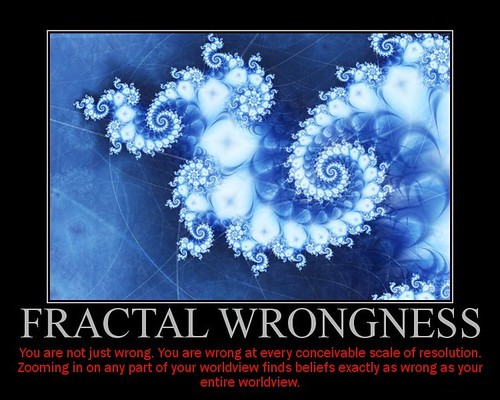
Yomin Postelnik, poster-boy for arrogant theistic fractal wrongness

Jan. 2009 Introduction & Addendum: The following snarkalicious post has since become somewhat legendary in the atheist/creationism/science blogosphere.

To cut a long story short, this is the one that led self-styled "conservative columnist" Yomin Postelnik to respond vengefully with bizarre edits to my Wikipedia entry (accusing me of all manner of crimes and misdemeanors, including fraud, drug addiction and pedophilia — vandalism that Yomin wasn't smart enough to realize would be stamped with his IP address, 74.233.115.163), to launch a series of blogs solely geared toward smearing me (since taken down), and to eventually make an Internet-wide nuisance of himself by posting to such forums as RichardDawkins.net and ChristianForums.com accusing me of harassment and something he called "Google stalking." This activity only led people back here, where they could see for themselves what Yomin was really up to, and that his histrionic claims of being victimized by "militant atheists" led by me was revealed to be projection at its worst. The only one engaging in unbridled harassment and defamation was Yomin, against me.

My opinion is that Yomin is not merely a thin-skinned adolescent unable to handle criticisms; I think he has full-blown narcissistic personality disorder. The Wikipedia entry on the condition notes, "To the extent that people are pathologically narcissistic, they can be controlling, blaming, self-absorbed, intolerant of others’ views, unaware of others' needs and of the effects of their behavior on others, and insistent that others see them as they wish to be seen... People who are overly narcissistic commonly feel rejected, humiliated and threatened when criticised. To protect themselves from these dangers, they often react with disdain, rage, and/or defiance to any slight criticism, real or imagined.... With narcissistic personality disorder, the person's perceived fantastic grandiosity, often coupled with a hypomanic mood, is typically not commensurate with his or her real accomplishments." Yomin likes to imagine himself a powerful and influential leader, and anything that threatens to tarnish this inflated self-image is met with ferocious outbursts of emotion.

The second half of 2008 appears to have been the worst six months of Yomin's life. In September of that year, he had his pre-paid legal service send me a cease-and-desist letter, which was odd, because I wasn't doing anything to him while he was actively maintaining no fewer than three anti-Wagner blogs. It transpired that this was a lame attempt to intimidate me into removing posts from this blog revealing his libelous activities. Basically toothless, because C&D letters carry no legal weight. In response to this, to get Yomin, basically, to pull his head out and back off, my attorney filed an online defamation suit at the end of October. Dumb luck, however, smiled on Yomin here, because for two months, the investigator employed by my lawyer in Florida claimed he could not find Yomin, and the two addresses we had for him were no longer current. This kept Yomin from actually being served for two months.

At the end of December, Yomin sent me a bizarre array of increasingly unhinged, delusional and vituperative emails, alternating pleas to end our conflict (which was entirely of his own making) with threats of further harassment if I didn't take certain posts down from this blog. I forwarded all of these to my lawyer, who advised me that the whole affair was "just getting petty...you need to get this guy out of your life!" Also, to continue to pursue the suit would cost thousands of dollars I didn't have. I had raised the filing fees initially through the help of online donations promoted by folks like PZ Myers. But I didn't feel right continuing to go back to the same people for more money, when this was, truthfully, turning into a childish battle of egos in which Yomin was simply baiting me and trying desperately to drag me down to his level of juvenile vindictiveness. Therefore I agreed to a tentative truce with Yomin at the end of 2008.

Part of me regrets this, as, given Yomin's narcissism, it basically means he thinks he "won" and that he's been able, essentially, to get away with the kind of behavior that, had he been held accountable, would have (hopefully) resulted in some desperately needed character building. The evidence I had linking Yomin to the Wiki vandalism was, in my opinion, ironclad enough to assure a court decision against him. But I didn't want to do this out of other people's pockets, and, knowing the personality type I was dealing with here, it is dead clear that a legal victory against Yomin would have been portrayed by him as further evidence of his victimhood. It is simply better to have this poor sad fellow gone.

In his last emails to me, Yomin, in a revealing moment, exclaimed, "I have to defend my reputation." What the narcissist never understands is that any damage to his reputation is the fault of his own actions. Ultimately, I decided it simply was not my job to help Yomin grow up. Materially, I had not been hurt in any way by Yomin's foolish behavior, while Yomin's name ultimately became synonymous with online hysterics of the most absurd sort. One of our commenters coined the phrase "pulling a Yomin" to refer to anyone having a four-alarm meltdown online. That's a legacy hard to undo, and, in its way, more deflating in the long term than even a court decision.

So, enjoy the following, if you are so inclined.

It's been a while since I bloodied my knuckles and let some smug ignoramus have it right in the teeth. So I figured it's time. This is a l-o-n-g one, but a fun one. I hope.

Via Dawkins' site, I learn of a lengthy essay over at Canada Free Press by a nincompoop with the improbable name of Yomin Postelnik, with the grandiose title of "Logical Proof of the Existence of a Divine Creator, Why Atheism is Not Logically Sound". If you thought Ray Comfort was a cocky assclown, you'll love this guy. Postelnik fancies himself a master of logic (if not proper punctuation or English), and yet doesn't seem to notice that his entire, long-winded blather amounts to one spectacular logical fallacy, namely, the argument from incredulity, with a heaping side dish of straw men. Here he sums up his whole position on why atheism is logically unsound.

No one in their right mind would claim that 10,000 hundred story buildings built themselves from randomness, even over time. Yet those who doubt the existence of a Creator believe that an entire universe, containing all of the billions of elements necessary for life to form, may have come about without a builder. As such, they give credence to billions of times more coincidences to having come about.

Ah, yes. It's the old "just look at all the trees!" argument that Matt Dillahunty and I goofed on on the TV show last week, just on a slightly grander scale. Apart from making the fundamental dumb apologist mistake of inferring design in nature from observing it in known artifacts like buildings — I'll explain why Paley's famous "watchmaker" argument actually does not demonstrate intelligent design in nature a little later — Postelnik's whole rant reveals little more than boilerplate religious scientific illiteracy, total ineptitude at this whole "logic" thing for which he repeatedly flatters himself, and a laughable tendency to recycle any number of long-refuted and feeble apologist canards as if they were amazing new concepts no atheist had ever considered before.

Let's have fun going through Postelnik's catalog of failings here, shall we?

Reading through this, you might wonder: why bother? Postelnik is so stupid that he can say this with a straight face: "Would human beings survive if one organ or cavity was missing or displaced, even after somehow being otherwise perfectly formed with no designer?" Well, knowing, as I do, several people who have had kidneys, bladders, appendixes, uteruses removed, I'd say, well yeah, duh. He's so silly that he launches his whole article with false analogies and unsupported a priori assumptions like this, which reveal the pitiful depth of his idiocy in living Technicolor...

The simplest proof (yet one that no atheist has ever been able to counter effectively) is that a universe of this size and magnitude does not somehow build itself, just as a set of encyclopedias doesn't write itself or form randomly from the spill of a massive inkblot.

Well, I bother because millions of people sadly think like this twat, that's why, and they're the ones launching all-out assaults on science education around the world in the name of their invisible magic sky fairy. It's incumbent upon atheists not merely to refute their nonsense, but to take some of the air out of their puffed-up egos by blasting it to smithereens and peeing on the ashes to boot. I've written before about the way Christianity allows its dumbest believers to adopt an air of faux-intellectualism. Here the stupid is unmasked for all to see, and laugh at. Postelnik is the very model of fractal wrongess.

  1. Postelnik thinks scientific explanations are all about "random chance." Towards this end, he offers up variants on the old "tornado in a junkyard" argument.

    [Atheists] believe that not only did whole planets appear spontaneously, but also believe that the fact that these planets do not collide as meteors do, that they have gravity, that they contain the proper atmospheric conditions for life to take hold and contain sustenance to sustain this life all happened by mere fluke.

    Reality check: Naturally, nothing in science (let alone atheism) promotes any of the nonsense Postelnik spews. Where in physics or cosmology is the theory proposed that planets emerged "spontaneously," or that collisions between worlds never happen? (Such a collision is, in fact, why we have a moon, and an asteroid belt between Mars and Jupiter.) Nowhere, of course, but Postelnik is typically butt-ignorant of the science he attacks and, like so many apologists, doesn't realize what a fool he's making of himself parading his lack of education in public. Planets, as any first year astronomy student will tell you, form within accretion discs of dust and other particles surrounding a star. Gravity, which Postelnik seems to think of as some ineffable magic property (he refers to celestial bodies as "possessing" gravity) when it's nothing more than the natural attraction between objects based both on their respective masses and the inverse square law, eventually causes the particles in all this whirling dust to coalesce into planets. It is only a "spontaneous" process if you're a fool who thinks spontaneity takes place over lengthy periods of time. But that seems to be a basic misunderstanding of creationist twits.

    Here's what Postelnik is too thick to grasp. Science understands the eons of time required for celestial objects like stars and planets to form. And instead of the mere guesswork Postelnik seems to think scientists engage in (typical twaddle: "...they outrageously chalk up to coincidence billions upon billions of times more detail and design in all parts of life found in this universe"), there are in fact well understood laws upon which everything in the universe operates. The "spontaneous" appearance of a planet or a life form would, in fact, refute everything science understands about how nature works, since science does not argue for the spontaneous generation of these things. The laws of physics allow us to understand why planets, once they are locked in their orbits, don't collide willy-nilly, though eventually their orbits could change or decay, and then they could. After all, whole galaxies collide, so certainly planets could.

    (Incidentally, you would think that with all his dogging on science, Postelnik ought to have some pretty impressive CV's, don't you? Well in fact...I know this will come as a shock...no. His bio identifies him as "the President of IRPW, a company that offers business plans, funding advice and facilitation, SBA loan applications, SWOT analyses, bold and effective marketing strategies, general business development and grant writing and research for non-profits and certain qualified businesses." Clearly he has all the expertise he needs to explain why all the world's leading astronomers, physicists, cosmologists, and biologists are wrong. One hopes, for the sake of IRPW's business clients, the "research" Postelnik does for them isn't as deficient as that which he's done here.)

  2. Again with the "spontaneity"! Postelnik continues to demonstrate he snored his way through junior high science class by bringing up "spontaneity" straw men over and over again.

    Even if all the planets somehow formed themselves, all somehow staying in perfect orbit and possessing gravity, even take for granted that all the chemicals needed for life were so how [sic] there as well, by sheer happenstance, would it then be possible for billions of species to spontaneously come about, each with a male and female of each kind so that they could exist in the long run?

    Reality check: I'll take "Scientifically Illiterate Verbal Diarrhea" for $1000, Alex.

    Let's set aside the fact planets didn't "somehow form themselves," they were formed by well-understood natural laws. Let's set aside the fact that most life on Earth is microbial, with many species reproducing asexually, some reproducing both sexually and asexually, and some, like viruses, unable to reproduce on their own at all. Let's set aside the fact that, while the ultimate origins of life are still an open question, no one in science is arguing for its spontaneous — as in "poofed into existence in a puff of smoke" — emergence. Let's set aside the fact that the vast majority of Earth's life forms, even the ones like dinosaurs who had the run of the place for far longer than we have or will, have eventually gone extinct. Let's set aside the fact that, for over a billion years of Earth's early existence, the whole planet was unable to harbor life. In fact, let's set aside every fact that science has established about the development of life at all. And once we're that stupid, we can begin to think along the lines of Yomin Postelnik. Because it's only through a totality of ignorance that one can hold the views he holds.

    Where does his whole obsession with things popping up spontaneously come from? Why, from religion, of course. Remember, it isn't science claiming that stars, planets, galaxies, people and puppy dogs emerged spontaneously. It's religion. You know, God said "Let there be," and poof, there it was. That's how tards like Postelnik think things really did happen. And once you think things really did happen in that way, then certainly it will seem illogical to think they happened that way all by themselves, without some agency bringing them about. But of course, things did not poof into existence spontaneously. Not even the universe. Remember: the Big Bang theory is not a creation ex nihilo theory. The Big Bang only describes the event that caused the universe to expand into its current state. There had to be something to go bang in the Big Bang, after all.

    Nothing in science, outside of the more esoteric realms of quantum mechanics, argues for the spontaneous creation of things from nothingness. Religion does. Postelnik is, hilariously, attacking his straw man of science by accusing it of making the very claims his religion makes. The problem isn't that Postelnik doesn't accept spontaneous creation. Being religious, he does. But religion offers up a god, and science doesn't, and so in that context, science has the sillier explanation, you see? This is how people with a head full of Bronze Age myths and no education in actual science think. Pathetic, isn't it?

    Postelnik babbles on a bit, repeating his bogus analogies (remember, encyclopedias couldn't write themselves!), occasionally pausing to compliment himself on his brilliance (he has to, as no educated person would), ignoring all of the detailed fields of scientific study that do in fact show that everything we observe in nature can very easily evolve and develop over time. Like many apologists, he seems to think blustery rhetoric constitutes evidence.

    Then he offers up what he thinks are three "stand out" arguments for God, which have been demolished many times, and which I will now demolish all over again.

  3. And the "stand out" arguments are: (And savvy readers will note that Postelnik isn't even clear on what he does claim to believe. His definitions of the three following arguments are rather confused and conflated, overlapping one another oddly. The way he defines the anthropic principle is closer to the definition of the first cause argument, while his definition of the teleological argument actually sounds more like the anthropic principle. The man argues like a drunk driver.)

    • The anthropic principle.

      Postelnik thinks: The anthropic argument contends that the universe is too complex to have no Creator. This is in effect the central point of this column, although explained in a more common manner.

      A more foolish manner, you mean. Let's deal with the obvious initial objection, which is that if complexity requires a Creator, then that Creator must be at least as complex as his universe and must have had a Creator too, and so on, ad infinitum. I mean, it's just logical!

      The anthropic principle has been punctured so many times and in so many different ways that one has to wonder just how many rocks Postelnik has been hiding under all his life to convince himself that "I have yet to meet an atheist who can make even a feeble argument to counter any of these points." I don't get the idea he's met many atheists at all, and certainly has read no atheist literature, all of which has nuked every silly argument Postelnik proudly flogs. To date, the most interesting and unusual refutation of the AP isn't so much a refutation at all: in The God Delusion, Dawkins makes the fascinating point that the AP is not an argument for God, but a substitute for one. Properly understood, what is known as the Weak Anthropic Principle fully supports a naturalist explanation of reality.

      Douglas Adams lampooned the AP in his famous bit about the puddle of water remarking on how amazing it was that the hole it was in was so perfectly formed to contain it. This is the problem with the AP if used to support theism: it's a tautology. Any universe whose properties for supporting life such as ours we could marvel at would have to be one in which we existed in the first place. This fact alone says nothing about a godly designer, nor does it address the likelihood of other possible universes containing entirely different properties, under which entirely different forms of life might arise. Hey, the believer might say, there's no evidence for those other universes, so that's just hypothetical guesswork! To which we say, by Jove, I think you've got it! Your God is the same kind of hypothetical guess, chum. At least the concept of other universes or other physical properties for sustaining life are hypotheses about natural rather than supernatural things.

      Understood as supporting natural processes, the AP points out that life developed after an environment in which it could exist arose. We, along with millions of other species (making the term "anthropic" both arrogant and inaccurate — since dogs exist, why do we never hear theists argue the "caninopic" principle?), were fortunate enough to be that life. Such an environment could just as easily not have arisen, as in the false start we see evidence of having occurred — remnants of vast flows of water, etc. — on Mars. In other words, we have been fine-tuned (by the ongoing processes of evolution) for our environment, not vice versa.

      The vast bulk of this universe is deeply inimical to life. Most of it, as Postelnik might have overlooked, is hard vacuum hovering around zero Kelvin. And of all the planets we know of, ours is the only one we yet know of teeming with life.

      An all-powerful universe-creating God could easily have populated every single planet and satellite and asteroid out there with highly advanced forms of life. Argue for an all-powerful God, and suddenly the need of the universe to possess specific properties for the support of life becomes superfluous. Unless the theist wants to argue that natural laws don't permit that. In which case, they've just argued their God is subject to (thus not transcending) natural laws, and not likely to be the creator of them. An omnipotent being would not be bound by the kinds of natural laws that keep the planets on their courses, and only allow life on our little blue globe while seven other perfectly lovely planets full of pretty exotic real estate go to waste. He wouldn't need to "fine tune" the universe for life. He could merely say, as the Bible has him say, "Let there be..." and there it is.

    • The cosmological argument.

      Postelnik thinks: The cosmological argument maintains that finite matter (original matter, which was clearly finite) cannot create a universe that is greater than itself.

      The cosmological argument is better known as the "first cause" argument, one basic objection to which I've mentioned above: the problem of infinite regress of Gods. Postelnik adds confusion to the whole thing in trying to skirt this objection, by qualifying his version of the argument to state that "finite matter...cannot create a universe that is greater than itself." But he offers no support for this simple assertion, and in terms of its content, it's really nothing more substantial than the creationists' routine insistence that complexity cannot arise from simplicity through natural processes. Postelnik simply wants to throw the phrase "finite matter" into the mix as a way of differentiating his God, which he naturally assumes is "infinite matter." But in making this distinction, our Master of Logic has fallen into another fallacy, that of special pleading. Nature has to obey these particular rules which disallow it from creating a universe, says the apologist. So here is my God, who doesn't have to obey those rules. Convenient, eh?

      Cosmological arguments answer no questions at all while raising more than they ever can. Why make assumptions about the supposed limitations of "finite matter," and what evidence does Postelnik provide for the "infinite matter," a.k.a. God, that he clearly sees as the "logical" alternative? Why assume, even if such "infinite matter" exists, that it needs to bear any resemblance to Postelnik's ideas about a God? Finally, the fallacy at the core of cosmological arguments is that they assume knowledge of conditions at the beginning of the universe — mainly, that it was "caused" — that simply are not known. Their very premises are insupportable. They fail before they even get going.

    • The teleological argument.

      Postelnik thinks: Especially compelling is the teleological argument, that the existence of a Creator can be seen from the fact that the universe works in perfect harmony, as would a giant machine. Gravity, orbits, chemical atmospheres and all other ingredients needed for life to exist come together in unison to allow such existence to happen. An enormous machine that works like clockwork needs to have a Creator.

      Postelnik embarrasses himself hopelessly here. His scientific illiteracy is complete, and his fondness for bad analogies is simply spewing over. Again, good old natural laws that have been understood and derived through observation — all the way from classical Newtonian physics to the more exotic fields of study that new research and knowledge are just now opening up — are proving entirely sufficient to explain why the universe functions the way it does, and though we still have numerous unanswered questions, we don't need to invoke any magic man in the sky just yet to fill our knowledge gaps.

      And it's hardly a flawless, clockwork-like process. Some planets have atmospheres conducive to life (though ours is the only one we know of), most have deadly atmospheres or none whatsoever. There is evidence at least one of our sister planets, Mars, started out warm and watery, which would be life-friendly conditions, then failed. Where in that fact is evidence of a creating hand, let alone that of the Biblical God who supposedly made us in his image, whom Postelnik is clearly trying to argue for? If anything, what we observe about the way life has developed on Earth (and more importantly, where life has failed to develop) is ideal evidence of the way evolution allows organisms to adapt. Speaking of which: there are over 1,000 species of parasites that can live in the human body. Evolutionary explanations for why they exist make sense, but why would Postelnik's God need, let alone desire, to "design" such creatures to infect us? Is this part of his "perfect harmony"? Maybe it's part of our punishment for Eve's "fall," eh?

      Once more with feeling: argue for an omnipotent God, and all this talk about the universe needing to obey specific laws, work in "harmony" like a "machine," have only certain planetary conditions to harbor life, and all that, is so much superfluous noise. Postelnik's all-powerful creator God could, if he so wished (and, given this God's obsession with being worshiped by as many sentient beings as possible, there's no reason for him not to wish), have intelligent beings living on every planet in the solar system, on every airless asteroid, hell, even on the surface of the sun and floating in pure vacuum between the worlds. The great irony of apologists who employ such things as design and anthropic arguments is that they don't realize they are using limits to prove the existence of their limitless God. The premise of their arguments contradicts the nature of the God they're arguing for.

  4. And now for a little projection. Postelnik goes on to make a further fool of himself by throwing out some vacuous twaddle about how (he thinks) scientists think that will utterly fry your irony meters. After falsely claiming, without citing sources, that more scientists are embracing theism than otherwise, he goes into what can only be called weapons-grade projection. Try this on for size.

    However, we must realize that while the sophistry it takes to purport a falsehood can be easily countered, the person who has upheld such notions for decades must have each of his or her counterpoints addressed. This is able to be done smoothly, in light of the inherent logic that necessitates the existence of a conscious Creator, but it must be done thoroughly.

    Encouraging atheists to open their minds to pure logic and to possibilities that they hitherto only sought to counter or to avoid on any pretext also involves an emotional challenge for them, as they must open themselves to the possibility of having to shed preconceived notions that they’ve held firm for decades. And that, rather than facts, is the primary challenge to exposing them to insightful logic. However, if they are willing to address the issue honestly, a search for the truth should be of paramount importance and enough reason for them to take an open look.

    *snort* Yeah, whatever you say, Captain Logic.

    Postelnik also amusingly advises all us atheist sophists to read Anthony Flew's book, There Is a God. Thing is, Richard Carrier has investigated this book thoroughly, and even corresponded with Flew. And the fact is that the book was not written by Flew at all, but entirely by evangelical Christian Roy Abraham Varghese, who is given a co-author credit on the cover. And one of the arguments in the book is one that Flew, in a letter to Carrier, had abandoned before the book was published. (Questions about Flew's possible mental decline remain, but are ultimately irrelevant. If a former atheist suddenly became a theist, and did so on the basis of lousy arguments, that would not undermine the views of rational atheism. It would simply mean we had a stupid ex-atheist out there.) So if Postelnik wants to shore up his case for theism with another fallacy — argument from (ex-atheist) authority — he'll have to do better than Flew.

And ba-dee, ba-dee, that's all, folks. I was going to go on another round of ridicule over Postelnik's final paragraphs, in which he claims the Bible reveals the first and second laws of thermodynamics before any stoopid scientist ever thought of them, so there. (He grossly misstates both laws, unsurprisingly.) But by this point I would hope I've exposed Postelnik's staggering silliness in all its tarnished glory, and frankly I'm as tired of writing this as I'm sure you are of reading it (assuming you still are). Maybe you folks will have fun refuting those final paragraphs of his yourselves. The fellow is your typical fundamentalist apologist, an intellectual poseur through and through, and in his entire article he never once advances a single new argument. He merely recycles every tired falsehood and fallacy that defenders of the faith have tried again and again, and they work no better for him. The only novelty about Postelnik's writing is watching a bozo who thinks he's some kind of logical paragon when what he really means by "logical" is "Gawrsh, it makes sense ta me!"

Stick with, uh, your "bold and effective marketing strategies," dude, okay? I have no idea if you do that well, either. But it can't be as bad as your oh-so-"logical" attempts at apologetics. (Or as dumb as the way you chose to respond to this critique of your essay.)

Monday, June 09, 2008

Zondervan blog

Mike writes:

Great post! I’ll get this off to Chuck today and hopefully we’ll hear back from him shortly. It depends on his schedule, but I’ll keep you posted as I get word from him. I’ll probably post up Chuck’s reply on the Zondervan blog I’m thinking and link over to your post, etc. Thanks again.

Since I wasn't aware of the existence of a Zondervan blog, I went looking for it and thought you might like to take a look too. Here is the section dedicated to Chuck Colson.

I looked over what was previously written, and it looks as though Chuck's "blog tour" has already been in progress for a while, since around March. He appears to be dropping by apologetics-friendly blogs first to answer brief questions.

I haven't read all the others yet. As far as I can see, mine is the first atheist response (although I don't know whether others are still waiting on their response). Perhaps unsurprisingly, I also appear to be the only one who has written a long critique rather than a short set of basic questions.

Sunday, June 08, 2008

What to expect from Chuck Colson

A few weeks ago, I made the following requests of Mike, who has kindly put in the effort to set this up:

  1. Allow me to post any comments I have simultaneously to the blog and to him.
  2. Always provide a link back to the original post in his reply, so that readers can visit the source if they choose.
  3. Include a URL to at least the main blog page, and preferably to each post, in any printed material that may be generated based on our conversations.
  4. State in his first public comment that he intends to do this.

I would, of course, do the same.

I would also like to ask one more favor. As I'm sure you're aware, the web in general, and the blogging environment in particular, can be a pretty chaotic place. I have control over what I say, but I don't have any authority over the people who read and comment on our blog. We almost never moderate for content, which means that any random person can arrive at our site and say whatever they choose.

Recognizing this fact, I am sure you'll acknowledge that the comments section can be a wasteland of bad language and indelicate remarks. I will gladly agree to have a civil dialogue with Chuck, but there is no means by which I could enforce such a request on readers. From your direction, I'm fairly positive that any additional traffic we receive will include many comments which could be interpreted as "angry" and will accuse us of being everything from terrorist sympathizers to child molesters. This is past experience speaking.

If and when such comments come, I don't feel that they should in any way reflect negatively on Mr. Colson or his positions, and I ask that you extend the same courtesy to me. Please recognize the boundaries between posts and comments, and refrain from pulling quotes from other commenters to stand in place of what I am saying.

Naturally I mean no disrespect to the great majority of our regular commenters, who are of course almost universally courteous, witty, and attractive. I'm simply hedging against any drive-by postings that might make us atheists look bad.

I am posting this here so that you folks will understand what my expectations are. From my perspective Chuck Colson has agreed to these requests by proxy, and so if he doesn't honor them then I will politely refer back to this post and then end the conversation.

I don't really know what to expect in the way of future guests to this blog, but I would ask the regulars — not to hold back, but please be as friendly as you can manage with visitors who don't share the same perspective as you.

Saturday, June 07, 2008

Letter to Chuck Colson on "The Faith"

For a background on what to expect from this discussion, I request that regular readers of the Atheist Experience blog please visit this message before getting involved in any commentary.


Hello Chuck,

Let me introduce myself. I am a software developer in Austin, where I recently acquired a Master's Degree in Computer Engineering from UT. I am also a life long atheist, which makes me something of a rarity. The great majority of atheists I know started out religious and eventually deconverted. In my case, my parents are both physicists. My father is a staunch atheist, while my mother is somewhat more "spiritual" but still does not believe in a traditional god. I definitely take after my father in this area. Both parents come from a Jewish background as well, so I have had a variety of religious instruction including a bar mitzvah. I write for the "Atheist Experience" blog as a hobby, and I also appear regularly on a cable access TV show and an internet podcast on behalf of the Atheist Community of Austin. I am a confirmed family man, with a wonderful wife and a son who just finished kindergarten, and two stepdaughters, one teenaged and one young adult.

First of all, I want to thank you for asking me to participate in this dialogue, and for sending me a copy of The Faith. I often go out of my way to listen to and read material with which I disagree, as I find it educational to consider a variety of perspectives. The last full book I read for this purpose was Darwin's Black Box by Michael Behe, about three years ago.

In order to avoid confusion, let me define some terms. I designate myself an "agnostic atheist," a term that I presume you will deny has meaning, based on my reading of chapter 2. In an anecdote, you attributed an aspect of certainty to both words: atheists are certain that God doesn't exist, and agnostics are certain that no knowledge is possible. You acknowledged this as a rhetorical "ploy," and I agree: it leaves no word available to describe my view. I do not believe in the existence of any gods (hence I am an atheist) because I do not believe that sufficient evidence has been presented to justify one. I recognize that I do not "know" in the absolute sense whether there is a god or not (hence I am an agnostic), but remain in a default state of disbelief until such time as better support for one is provided.

The above is a summary of my use of the words, and I can support them from the dictionary if you really want to spend time nitpicking about definitions. Otherwise, if you are uncomfortable with describing me as an atheist, feel free to pick whatever word you want to apply instead. "Infidel" would suit me fine, for example.

As I read your book, one major theme to which you frequently returned was your contempt for post-modernism, which you see as the philosophical rejection of objective truth. In this case, I find myself on common ground with you. Speaking as a person with a strongly held respect for science, I have on several occasions found myself arguing with post-modernists. A certain breed of armchair philosopher loves to describe science as "just another religion," implying that it is arbitrary and irrelevant, and thereby ridiculing the idea that reality is something that can be investigated and understood. So I heartily share your general opposition to post-modernism.

I was troubled, however, by your method of arriving at a conclusion about what is true. Let me give you a small example, from chapter 4, titled simply "Truth." You wrote:

"The only thing the god of tolerance hates more than Christians making truth-claims is Christians proving them. Beginning with a facility in Houston, Prison Fellowship now runs residential programs, 'spiritual boot camps,' within prisons in locations scattered across the country. This is called the InnerChange Freedom Initiative — or IFI. We have, since the beginning, contended that these demonstrate the truth of the Gospel in transforming lives. University of Pennsylvania researchers reported that IFI graduates had an 8 percent re-incarceration rate versus 20 percent in a comparable control group (and 67 percent nationally). Prison officials were astounded.

"It was the first empirical evidence that this faith-based approach to corrections works -- in other words, that the Gospel is true. And that's when Barry Lynn of the Americans United for Separation of Church and State decided to sue. To prove our truth-claims proved an outrage that tolerance could not abide."


In a brief endnote, you mentioned that you actually lost that case and IFI was ordered to cease and desist. However, you didn't trouble yourself to explain why.

In fact, I had already heard about this study, but I had to go and look it up again to see if your claims were right (in an objective, factual, and decidedly not post-modern sense). What I discovered was that when you claim a re-incarceration rate of only 8 percent, you are not describing all people who took your program. Instead, you selectively defined a graduate of your program to be someone who remained with the "boot camp" until their release, and then got and held a job outside of prison. In other words, someone could go through the program, be paroled, attempt to re-enter society, and STILL not be considered in your statistics if they failed to find a job.

I sometimes say that if you take an aspirin and pray to God, then your headache will go away. But that doesn't mean that the prayer was what cured your headache. The situation that you've offered is similar: if you get a job and go through spiritual boot camp, then you'll be less likely to go to jail, leaving you free to jump to your own conclusion about which one was the cause. People who have a job and money are less likely to commit crimes -- this is true whether they take your program or not.

That doesn't mean that IFI can take credit simply for disqualifying participants without a job from the survey. It would be like writing a rule that says their graduate status is automatically revoked if they ever go back to jail. If such a rule existed, then you could claim a 0% recidivism rate among "graduates," and this would remain true even if the program accomplished nothing constructive at all.

I'm no sociologist, but I have taken a few classes on statistical methods and data analysis in my time. One of the first things that anyone should learn about citing a study is that if you taint the set of data in advance to selectively mask underlying causes, then any results you come out with are meaningless. And in this case, when you look at the whole of the study which you claimed provided "empirical evidence that this faith-based approach to corrections works," what you find is that among all people who enrolled in your program, the recidivism rate was actually worse than the control group.

(Here is a link to the original study. On page 5 it is revealed that "Among the total number of IFI participants, 24.3% were incarcerated compared to 20.3% of the comparison group during the two-year post-release period.")

This is just one example of a cavalier attitude toward the facts in evidence, and it puts a very different perspective on your pursuit of "capital T Truth." What you describe as "Truth," on many occasions I perceive as "an unwavering certainty in situations where none is warranted." Or to put it more succinctly, "faith."

The scientific method is built primarily on the principles that:
  1. There is objective truth that may be discovered through investigation, but
  2. Human perception of that truth is always subject to errors

In other words, science embodies the principle that we should always be vigilant against the possibility that we may be wrong, and be ready to recognize mistakes even in our own deeply held opinions.

I don't see this kind of acknowledgement of your own fallibility in your writing. Even though you see things in terms of the fallen nature of mankind, you feel sure that the omniscient creator of the universe wrote a book which contains the answers to everything, and that your own interpretation is always the right one. From where I sit, this looks as if you have granted yourself infallibility. As long as your beliefs are in tune with what you think God wants, no error is possible.

Yet being certain is not necessarily the same thing as being right. Several times throughout the book, you emphasize the role of Christians who fought for the abolition of slavery, an act that we both applaud. You also dismiss the role of Christians who fought for the preservation of slavery. You curtly acknowledge their existence in chapter 12 by saying "It's true that some Christians have been hypocritical about slavery, condoning it for too long. The record of the church is not without blemish."

As I do not share your inclination to defend the Bible, it's not clear to me that this is hypocrisy at all. Far from disregarding the Bible's advice, many devout 19th century Christians saw the Bible in itself as proof that slavery was an act sanctioned by God. For example, in 1856 Reverend Thornton Stringfellow, a Baptist minister from Culpepper County in Virginia, wrote an essay called "Scriptural View of Slavery", which is full of passages that support his opinion, such as:

"Job himself was a great slave-holder, and, like Abraham, Isaac, and Jacob, won no small portion of his claims to character with God and men from the manner in which he discharged his duty to his slaves."

"See Lev. xxv: 44, 45, 46; 'Thy bond-men and thy bond-maids which thou shalt have, shall be of the heathen that are round about you: of them shall ye buy bond-men and bond-maids. Moreover, of the children of the strangers that do sojourn among you, of them shall ye buy, and of their families that are with you, which they begat in your land. And they shall be your possession. And ye shall take them as an inheritance for your children after you, to inherit them for a possession, they shall be your bond-man forever.' I ask any candid man, if the words of this institution could be more explicit? It is from God himself; it authorizes that people, to whom he had become king and law-giver, to purchase men and women as property; to hold them and their posterity in bondage; and to will them to their children as a possession forever; and more, it allows foreign slaveholders to settle and live among them; to breed slaves and sell them."

"This, by the way, is a singular circumstance, that Jesus Christ should put a system of measures into operation, which have for their object the subjugation of all men to him as a law-giver--kings, legislators, and private citizens in all nations; at a time, too, when hereditary slavery existed in all; and after it had been incorporated for fifteen hundred years into the Jewish constitution, immediately given by God himself. I say, it is passing strange, that under such circumstances, Jesus should fail to prohibit its further existence, if it was his intention to abolish it."

"If, therefore, doing to others as we would they should do to us, means precisely what loving our neighbor as ourself means, then Jesus has added no new moral principle above those in the law of Moses, to prohibit slavery, for in his law is found this principle, and slavery also."

So you can see here that faith and conviction in the truth of the Bible were at one time used to support the continuation of slavery. I don't think that Reverend Stringfellow's faith was any less sincere than yours; even though I think, as you do, that he was wrong.

Please don't assume that this way of thinking is too old-fashioned for modern, enlightened Christians. I have engaged in many conversations with very earnest Christians who, rather than explaining away passages such as those in Leviticus which clearly prescribe slavery, worked hard to justify them. They argue that "Biblical slavery" was very different from the slavery in the American South, and that it simply wasn't such a problem for those living in ancient Israel to own slaves as long as the slaves were treated humanely. In a few extreme cases, I've even had Christians essentially tell me that having a job is no worse than being a slave, and it would therefore not be such a bad thing if "Biblical slavery" still existed.

Christians arguing for slavery? Is this the fault of post-modernism and relativism? Or is it simply an honest effort to reconcile a book which is "known" to contain absolute immutable truth? Assuming that your faith is incompatible with slavery, by what method should I choose the truth-value of your faith over the faith of Stringfellow? I could apply reason based on core values, of course. But if this is possible, as I think it is, then I would argue that "faith" is a useless contribution to the discussion altogether.

One of the main things that motivates my atheism -- beyond the simple fact that I do not see any compelling reason to believe in God -- is that I cannot regard faith as more reliable than evidence as a means to learn about truth. Sometimes I must make decisions without enough evidence to be certain. In those cases, I recognize the possibility that I may be wrong, while still choosing to believe whatever best fits the available facts; and I expect that my beliefs may change when new information is available. This is not similar to the Biblical description of "faith," which is "being sure of what we hope for and certain of what we do not see." (Hebrews 11:1, NIV translation) It is this sense of "being certain" despite a lack of evidence that troubles me.

The perpetrators of the 9/11 attacks had a tremendous amount of faith. You can say whatever unflattering things you want about their actions and their motives, and I'd certainly agree with you; but one thing you cannot accuse them of is a lack of faith. I see no reason to think that they did not sincerely believe their own doctrine which said that they would be honored as martyrs in the afterlife and awarded 72 virgins.

Was it a bad thing to do? Absolutely. Many innocent people were hurt and killed due to the faith of the hijackers, and that is a terrible thing for the victims and their families; it is also extremely sad for the rest of us, as people who have empathy and compassion. Yet if I were to speak reasonably to a fundamentalist Muslim, as I am speaking to you now, I do not think I would be able to persuade that Muslim that he was wrong. Why? Because he doesn't believe that there is any such thing as truth? Of course not -- it is because he has very concrete beliefs about the truth of his god, which cannot be proven on the basis of observation or reason, but which are confidently accepted on the grounds of faith.

Throughout your book, you lumped unbelievers in with both post-modernists and radical Islam as cooperative forces that you imagine are working to destroy our culture. From my perspective, this is a categorical error. On the contrary, I tend to think that what divides "us" from "them" is not which religion is claimed by the majority of citizens. It is our willingness to recognize that although people have different opinions, it is worth the effort to communicate with them and resolve our differences peacefully. War is an option, but a last resort. We even understand that other people might continue to believe things that are wrong, and yet strive for a solution that involves conversation rather than blowing stuff up or crashing airlines. I know you must desire this approach in some cases, because you sent me your book and asked for a dialogue, even though it is clear from your text that you believe I am your enemy.

Ultimately I reject the faith of the hijackers as insufficient grounds to claim knowledge, just as I reject yours. This leaves me free to judge their actions and yours based on the consequences, as viewed through the lens of my values and my concerns about justice. You may say that this is subjective, and perhaps it is. Unlike "the physical world," which can be observed, values are ultimately the domain of the person who possesses them and the society in which they live. You presume that your values are the same as the values of a god who is always right. But in thousands of years of the Judeo-Christian-Islamic tradition, faith and devotion have been used to defend slavery as often as condemn it; to promote unproductive wars as often as prevent them; to suppress freedom as often as to champion it.

By no means does this imply that I think all atheists are wonderful, nor that Christians are evil. Certainly not in the same sense that you seem to believe my point of view is evil. On the contrary, from reading the historical anecdotes that you highlighted in the second half of your book, I would venture to say that we admire many of the same character traits in people, and love many of the same aspects of humanity.

In practice, though, I believe that you make many clear factual mistakes due to your insistence that belief in God and Jesus can never steer you wrong. And because I am still not impressed with the arguments for the accuracy of the Bible -- which we can discuss in future correspondence, if you wish -- I ultimately don't feel that supporting your faith is worth enough to justify the extreme tolerance for error.

Thanks again for initiating this discussion, and I look forward to your reply.

Sincerely,
Russell Glasser

The antidote to Expelled?

This looks like it will be really very funny.

Wednesday, June 04, 2008

sniff... Is nothing sacred?

Even Jesus is being stolen and sold as scrap!

God's anger and jealousy prove his unfailing "love"

One of the more bizarre aspects of Christian belief is the way it turns fundamental concepts like love and goodness completely inside out, to the evidently enthusiastic support of the faithful. I have been in an on-again, off-again discussion with a Christian called SuperFlyingNick on YouTube, and here he makes the following case for God's love. Does any of this strike you as internally contradictory and self-refuting?

I am not surprised that you feel that my God is made up in the minds of men. I've heard plenty of people say that.

And I understand that the Bible says God made man in His own image. However, the characteristics you described to me are very unique to God. I'm not saying that humans can't be loving and so forth, but God's love is genuine and unfailing - something humans will never posses. God is jealous because he doesn't want you to have any other gods before him (he wants your attention). His mercy is the fruit of his love, and his anger goes along with his jealousy and how humans can be disobedient.

If you really think about it, God's characteristics are pure and genuine.

And I respond:

I confess to being utterly baffled at the way in which Christians are willing to accept jealous anger as some sort of indicator of "genuine, unfailing love." Is it truly the benchmark of "genuine" love that it comes with a jealousy and possessiveness that erupts into anger if the love is not returned? I cannot for the life of me think so. This is more like the love of an abusive spouse. If a man told a woman, "Honey, I love you, but so help me, if I ever see you so much as look at another man, I'll break your neck," most people would not consider that any kind of love, least of all "genuine" and "unfailing," and indeed they would do all they could to convince the woman in question to leave that man as fast as possible. But when their God essentially behaves the same way, erupting with jealous wrath and consigning people to eternal torment for failing to reciprocate his "love", Christians seem to think this is all A-OK. One rule for people, another for your God, apparently.

I cannot see any reason to declare my allegiance to anyone — deity or otherwise — simply because not to do so means they'll be angry with me and hurt me. For one thing, on God's part, that isn't love, merely power and control, and on my part, it wouldn't be love either, merely fear. That Christianity has persuaded millions of its followers to be convinced that power, control and fear are all examples of "loving" behavior is deeply disturbing, as they really distort what love really means out of all recognition. Doing something because you fear being hurt otherwise is known as terrorism.

In any case, it makes no sense that, if God is — as Christians describe — a "perfect" being, that any lack of attention or obedience from me or anyone else could matter to it at all. For God to be perfect means that there is nothing you could possibly add to him to improve him in any way, nor is there anything you could deny him that would damage that perfection. No perfect divine being would care what I felt about him any more than I would care what the ants crawling on my windowsill think about me. For God to be described as perfect on one hand, and jealous, angry and wrathful on the other is an oxymoron. And anything that contradicts itself cannot exist.

PS: This is the AE blog's 500th post. Yee!

Finally!

Jeezis. And I thought the format war between Blu-Ray and HD-DVD discs was the ultimate example of a completely lame and unnecessarily drawn-out battle towards a foregone conclusion. Now that Barack Obama has the delegates to get the Democratic nomination — an outcome perfectly obvious and inevitable for a long time to all but Hillary Clinton and her most doe-eyed disciples — hopefully we can get on with things and enjoy an exciting campaign between now and November.

There seems to be a lot of pressure right now on Obama to offer Hillary his VP slot. I'm agin' it, mainly because I dislike Hillary intensely and am convinced she's simply been body-surfing her ego for the last several months, putting her ambition above the good of her party and the country. People praise Hillary for her never-say-die "fighting spirit," failing to recognize that that isn't a praiseworthy trait in and of itself. After all, creationists have plenty of "fighting spirit." If your "fighting spirit" is rooted in hubris and delusion, and a mule-headed refusal to acknowledge reality, then your role model for said "spirit" is the Black Knight from Monty Python and the Holy Grail. That isn't the kind of "fighting spirit" I want in the White House. It's what we've had for the past seven years, and look how that's turned out.

The argument for offering the VP slot to Hillary is that she does have a thoroughly fanatical contingent of supporters who seem to have bought into her ideas that the presidency is some kind of entitlement for her, and if she isn't the Democratic nominee, will cast a revenge vote for McCain in November, thus plunging the country into four more years of Republican-led foreign policy disaster (McCain has voted with Bush over the years on damn near everything, so anyone who thinks he's going to be a standard-bearer for "change" really needs to start taking better drugs) simply to salve their bruised feelings. Bring Hillary into the frame as Obama's running mate, and perhaps her supporters will chill and, most importantly, not jump ship.

Still, I can't help thinking that Obama's choosing Hillary for his running mate would be not unlike a long-suffering parent caving in and buying a toy for an ill-behaved and unruly child, simply to stop it constantly screaming and crying and carrying on. Not exactly a character-building choice, if you take my meaning. I've read from more than one source that an Obama/Edwards ticket will trounce McCain/Anybody come November, and that would be a ticket I could get behind with enthusiasm. Still, if Obama does choose Hillary (and she accepts), he will still get my vote. After all, my vote's not about my ego, it's about what I think will be the best way to undo the damage that eight years of the cretinous Bush have left us in. And that comes down to casting my vote for a fresh voice and a sincere agent for change, not a huggy sycophant.

Okay, Hillary lovers, bring it on...!

Monday, June 02, 2008

Judge lifts injunction against Expelled

In an interesting development, U.S. District Judge Sidney Stein (no relation to "Evolution Doesn't Explain Gravity!" Ben) has ruled that Expelled can use the 15-second clip of John Lennon's "Imagine" under the fair use doctrine. Over at PT, commenters are pointing out that this isn't an end to the lawsuit, but it may be moot at this point. I disagree with the decision — I think it could open the gates to all manner of dodgy copyright infringement — but at this point it really has no impact either way for Expelled, which is already out of theaters in the US after tanking with a pitiful $7.5 million haul after six weeks. The movie simply wasn't the takedown of science its producers were hoping for. But since they've created a nice little insulated world to live in, only exposing themselves to tightly controlled pre-release screenings to which the scientifically-illiterate choir were exclusively admitted, they'll never know that. So it's on to the church-basement DVD circuit, where it was going to end up anyway — while, off in the real world, science marches on and people with brains are actually learning new things.

I did find this part of the MSNBC article enlightening.

At a hearing last month, Falzone had argued that the segment of the song in the film — "nothing to kill or die for, and no religion too" — was central to the movie because "it represents the most popular and persuasive embodiment of this viewpoint that the world is better off without religion."

The film, he said, is "asking if John Lennon was right and it's concluding he was wrong."

It's a nice admission that religionists wouldn't think the world a happy place unless they had absurd ideologies and irrational beliefs to kill and die for.